







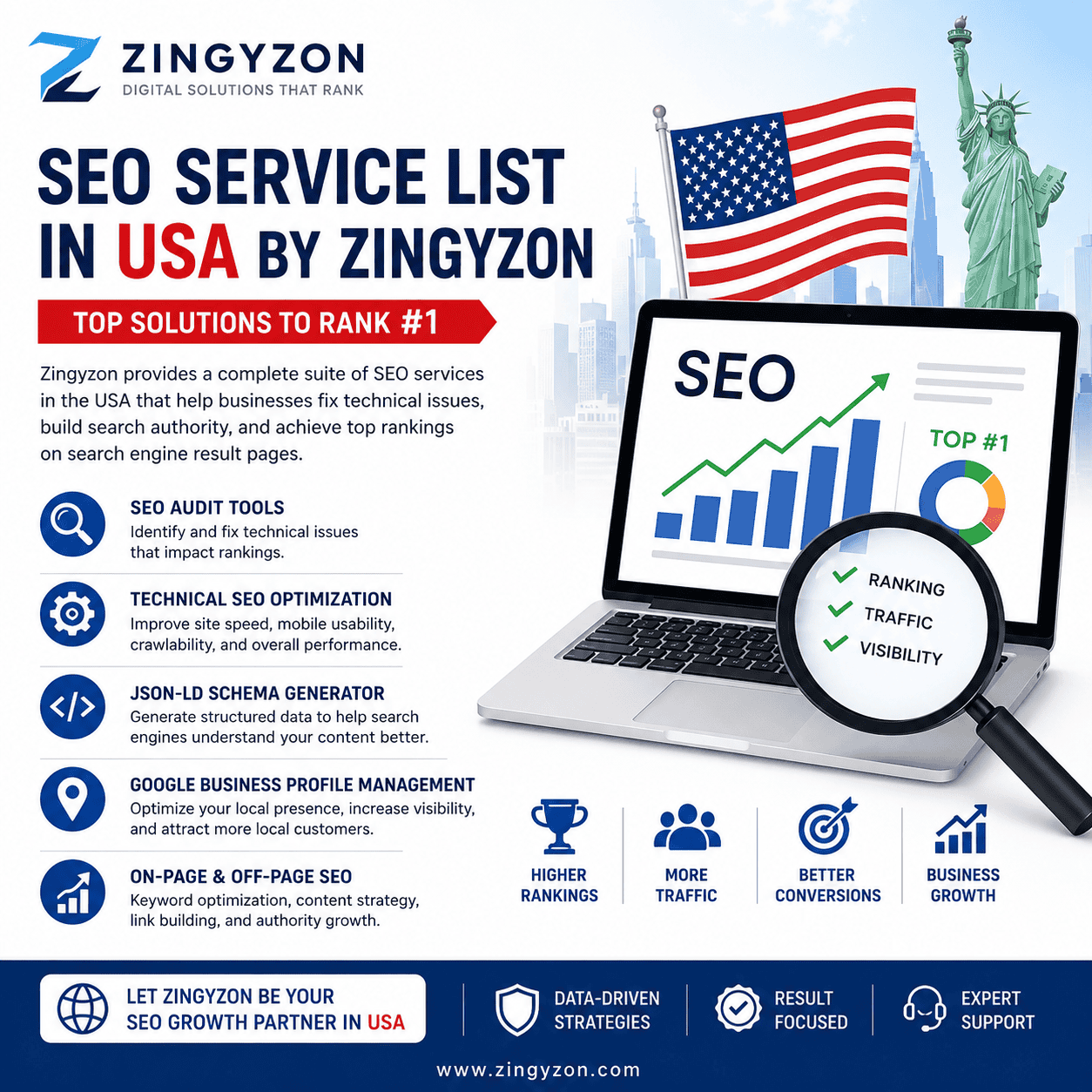
Zingyzon provides a complete suite of search engine optimization services in the USA, including specialized web-based audit tools, technical infrastructure optimization, structured JSON-LD schema generation, and local Google Business Profile management. These digital solutions help location-based businesses, e-commerce stores, and enterprise companies fix technical site issues, build search authority, and secure top ranking positions on search engine result pages.
Search Engine Optimization Tools Provided by Zingyzon
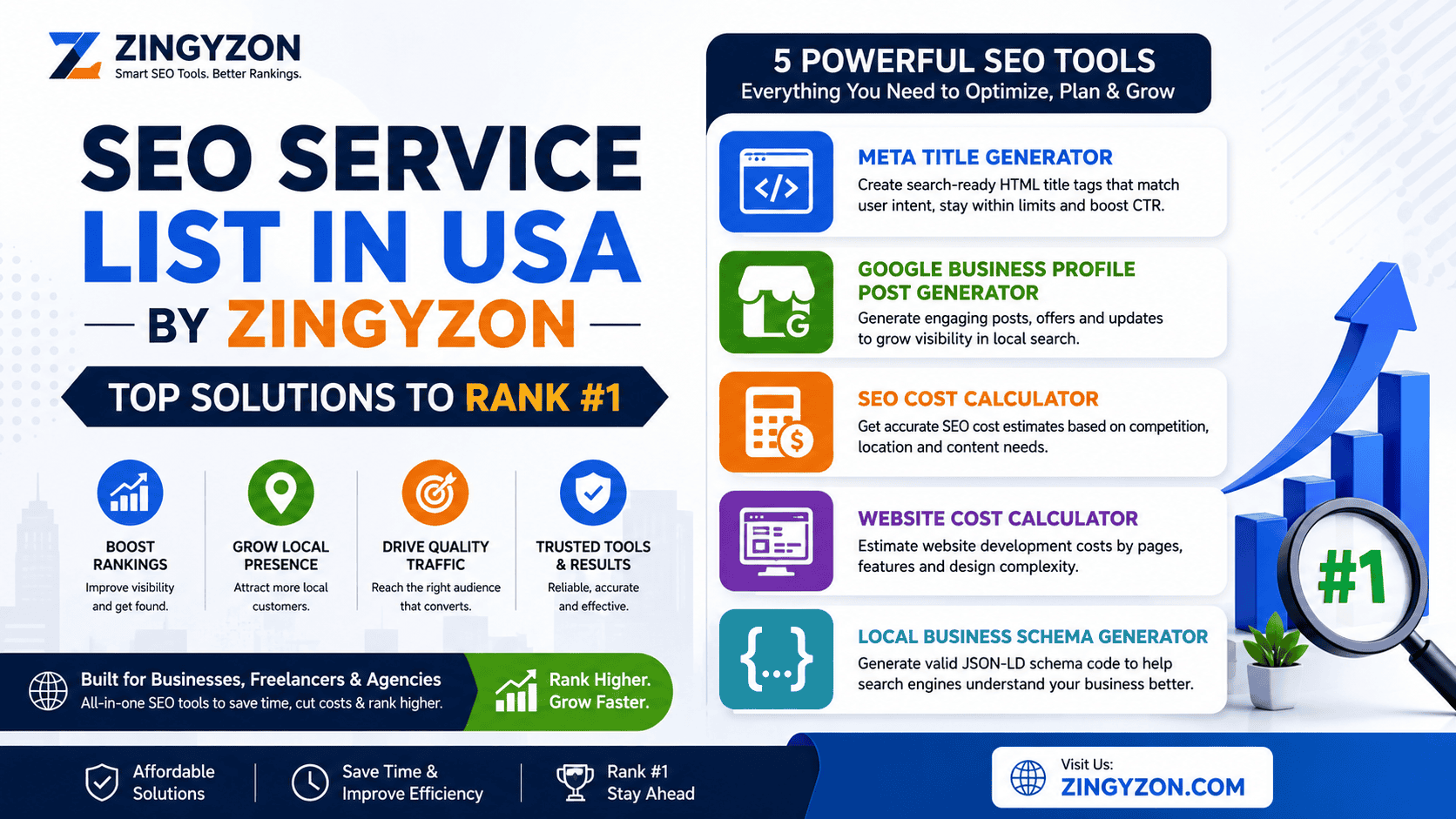
Modern search engine optimization relies on functional web tools that solve routine operational tasks. Zingyzon delivers a centralized suite of five web applications designed to solve technical and administrative search challenges without requiring expensive software subscriptions. These applications allow business owners, independent freelancers, and agency teams to perform essential optimization tasks efficiently.
The Meta Title Generator formats search-ready HTML title tags tailored for local service pages, commercial landing pages, and educational blog posts. HTML title tags remain a primary ranking signal for search engine algorithms. Properly formatted title tags match user search intent, stay within character display limits, and increase organic click-through rates from search engine result pages.
The Google Business Profile Post Generator creates structured promotional updates, event announcements, and service descriptions. Local search algorithms evaluate profile activity when ranking businesses in local map packs. The post generator creates clear copy that encourages potential customers to interact with local listings.
The SEO Cost Calculator provides clear budget estimations based on market competitiveness, target geographic scope, and content requirements. This tool helps business managers plan financial resources accurately before launching search engine campaigns.
The Website Cost Calculator estimates web development expenses based on page count, functional integration requirements, and custom design complexity. It gives companies clear financial projections before starting new website construction projects.
The Local Business Schema Generator builds valid JSON-LD structured data scripts. Search engines use structured data to verify physical location details, business categories, and operating schedules.
| Tool Name | Core Function | SEO Objective | Output Format |
| Meta Title Generator | Formats HTML title tags | Improves click-through rates | HTML title tag code |
| GBP Post Generator | Creates structured local updates | Maintains active profile signals | Plain text promotional copy |
| SEO Cost Calculator | Calculates campaign budgets | Clarifies resource allocation | Estimated monthly cost report |
| Website Cost Calculator | Estimates web development scope | Projects website setup costs | Functional cost breakdown |
| Local Schema Generator | Builds JSON-LD code | Verifies business entity data | Valid JSON-LD script |
Technical Site Infrastructure and Crawler Optimization
Technical site health forms the foundation of organic search performance. Search engine crawlers evaluate website code, loading speed, and structural security before indexing web pages or assigning search rankings. Technical optimization ensures search crawlers access and interpret website pages without encountering technical errors.
Managing crawl budget requires clean site architecture and proper directive files. XML sitemaps supply search engines with a clear list of all active URLs, allowing crawlers to discover new page updates quickly. Robots.txt files guide search bots away from private administrative directories, preserving crawl budget for valuable commercial landing pages. Canonical tags specify the master version of each page, preventing duplicate content issues across similar URLs.
Core Web Vitals and site loading speeds directly influence user experience and search rankings. Lightweight code, compressed visual assets, and simplified Document Object Model structures prevent page rendering delays. Fast server response times prevent browser timeouts and reduce page bounce rates on mobile devices.
Data security protocols protect online visitors while meeting modern search engine standards. Enforcing HTTPS protocols with TLS 1.3 encryption secures web communication across all page domains. HTTP Strict Transport Security rules instruct web browsers to communicate exclusively over secure HTTPS channels. Anycast DNS routing sends domain lookup requests to the nearest geographic server to reduce page load latency. Content Delivery Networks store static site assets on edge servers located near users, improving global page speed performance.
Large web applications require structured backend frameworks. Full-stack web applications use decoupled API setups communicating through RESTful or GraphQL protocols. Enterprise e-commerce platforms using Magento Adobe Commerce rely on an Entity-Attribute-Value database structure to manage large product catalogs efficiently under heavy user traffic.
| Technical Element | Configuration Requirement | Crawler Impact |
| XML Sitemap | Validated XML index of active pages | Accelerates content discovery |
| Canonical Directives | Self-referencing canonical tags | Eliminates duplicate indexing |
| HTTPS Protocol | TLS 1.3 encryption with HSTS enabled | Fulfills core security standards |
| Edge Caching | Content Delivery Network deployment | Reduces server load times |
| Mobile Rendering | Responsive layout design | Supports mobile-first indexing |
Structured Data Architecture and JSON-LD Implementation
Structured data markup provides search engines with standardized information about web page content. Zingyzon uses the JSON-LD format, which is the official structured data format approved by major search engines. Adding valid JSON-LD code into web page headers converts unstructured text into organized entity data that search algorithms process instantly.
The Local Business Schema Generator structures critical operational parameters for local companies. The context field links directly to official Schema.org standards, while the entity type defines the exact category, such as LocalBusiness, MedicalBusiness, or AutomotiveBusiness. The script contains the official trade name, primary telephone number, physical street address, and exact geographic latitude and longitude coordinates.
Detailed opening schedules are declared using structured time specifications. Setting exact daily operating hours helps search engines confirm when a business is open to serve customers.
Adding accurate schema code reduces data ambiguity across search indexes. Verified business details support higher rankings in local map packs and increase the likelihood of displaying rich search snippets, such as review ratings, operating hours, and location maps directly on search result pages.
| Schema Field | Technical Purpose | Sample Data Value |
@context | Schema vocabulary definition | https://schema.org |
@type | Entity category classification | LocalBusiness |
name | Registered trade name | Zingyzon Digital |
address | Physical location details | Street address, City, State, ZIP |
geo | Exact location coordinates | Latitude and Longitude values |
telephone | Primary phone contact number | +1-800-555-0199 |
openingHoursSpecification | Daily operational schedule | Opening and closing times |
Google Business Profile Optimization and Local Search Mechanics
Local search engine optimization helps location-based businesses reach consumers searching for nearby products and services. Search engines use three core factors to determine local search rankings: physical proximity to the searcher, topical relevance to the query, and overall business prominence. Managing Google Business Profiles according to updated practices builds strong local relevance signals.
Maintaining consistent business information across the web is critical for local search visibility. The business name, address, and phone number (NAP) displayed on a Google Business Profile must match real-world signs and local directory listings exactly. Small variations in business names or inconsistent address details create data confusion, which lowers local search rankings.
Category selection directly affects visibility in local map searches. The primary category serves as the single most influential local ranking factor. Businesses can also select up to nine secondary categories to describe additional products or services. Operating hours must remain accurate at all times, especially during holidays, to maintain profile trustworthiness.
Visual content increases customer interaction on local listings. Google profiles with authentic photos receive 42 percent more requests for driving directions on Google Maps and 35 percent more click-throughs to their websites. Images should be uploaded regularly in standard formats, maintaining resolutions around 720 by 720 pixels. Genuine photos of storefronts, physical products, and working staff perform significantly better than generic stock photos.
Publishing weekly Google Business Profile posts keeps listings active. Profiles can share three specific post types: general Updates, promotional Offers, and scheduled Events. Posts should place main promotional details in the first ten words and use built-in call-to-action buttons such as Book, Learn More, or Call Now. Placing phone numbers or excessive punctuation inside post body text violates quality rules and causes post rejections.
Managing customer reviews impacts search rankings and consumer trust. Responding to customer reviews within 48 hours demonstrates active profile management and strengthens local prominence signals. Service-area businesses operating without a public storefront can define up to 20 specific service areas within a maximum two-hour driving radius.
| Post Category | Publishing Frequency | Call to Action Button | Best Practice |
| Updates | Weekly | Learn More / Order Online | Share business news and new service options |
| Offers | Bi-weekly | Book / Claim Offer | Include start dates, end dates, and discount details |
| Events | Monthly | Sign Up / Book | Set explicit start and end times for scheduled events |
For more like it: Zingyzon SEO Strategy Guide | Boost Rankings & Organic Traffic Fast
On-Page Semantic Search and Content Architecture
On-page search engine optimization aligns web content with user intent and modern search indexing systems. Instead of repeating isolated keywords, semantic optimization focuses on thorough subject coverage, logical page structures, and clear topic organization.
Effective content strategy begins with thorough keyword research mapped directly to user search intent. Search intent falls into informational, navigational, or transactional categories. Targeting long-tail search terms attracts users with specific buying intent, resulting in higher conversion rates. Strategic keyword placement ensures primary target terms appear naturally in HTML title tags, main H1 headers, secondary subheadings, meta descriptions, and body copy.
Proper header tag usage builds clear content hierarchy. Each web page requires a single H1 header tag containing the primary topic, followed by H2 and H3 subheadings organizing supporting information logically. Clean URL structures using lower-case letters and hyphens make page topics easy for visitors and search crawlers to read. Image optimization requires descriptive alt text, allowing search bots to index visual content accurately while improving site accessibility.
Internal link structures pass authority across website pages. Linking informative blog posts to core service pages guides visitors toward purchasing actions and helps search bots understand page relationships. Maintaining active editorial publishing schedules prevents web pages from becoming outdated, preserving long-term search positions.
| Content Element | Implementation Standard | Optimization Goal |
| Header Tags | One H1 per page, structured H2 and H3 subheadings | Establishes clear semantic hierarchy |
| Keyword Mapping | Aligns content with search intent categories | Matches user search queries |
| URL Structure | Short, lower-case URLs separated by hyphens | Improves readable link structures |
| Internal Links | Descriptive anchor text pointing to relevant pages | Distributes page authority |
| Image Alt Text | Brief textual description of visual content | Enables image indexing and accessibility |
Off-Page Authority Building and Digital Outreach Standards
Off-page search engine optimization builds domain credibility using external authority signals. Search engine algorithms treat high-quality external links as third-party recommendations of a website’s overall trust and content quality.
Sustainable authority growth requires legitimate backlink acquisition methods. Earning editorial links from industry blogs, managing digital public relations outreach, and publishing original research data attract high-authority backlinks naturally. Local directory citations, press releases, web 2.0 articles, and professional Q&A contributions add variety to a domain’s link profile.
Shortcuts such as purchasing bulk link packages or using automated link building tools introduce severe risk. Search engine algorithms detect artificial link patterns quickly, resulting in search ranking drops or manual site penalties. Legitimate outreach focuses on building real industry partnerships and earning links on vetted websites that drive real referral visitors.
| Outreach Channel | Target Asset | Value Metric |
| Digital PR | News releases and data reports | High domain authority press links |
| Industry Guest Posts | Informative guest articles | Niche topical relevance and referral traffic |
| Local Directories | Profile citations | NAP verification and local authority |
| Content Syndication | Informative guides | Extended brand reach and contextual links |
Agency Evaluation Standards for Selecting SEO Partners
Selecting an effective digital marketing service requires objective performance evaluation standards. Zingyzon establishes benchmark criteria across four core operational areas to help companies select capable search engine optimization partners.
Technical audit competency tests an agency’s skill in identifying and resolving structural site errors. Qualified service providers must demonstrate mastery in fixing crawl budget limits, indexation blocks, canonical errors, and Core Web Vitals speed failures.
Semantic content optimization evaluates how well a provider creates content matched to search intent and topical clusters. Providers must use structured keyword mapping and produce content written for real readers without relying on artificial keyword stuffing or automated generation tools.
Off-page authority building assesses the legitimacy of an agency’s link acquisition methods. Reviewing link building methods ensures backlink growth comes from manual outreach, editorial guest placements, and verified directory citations rather than low-quality link networks.
Reporting transparency requires clear analytics configuration. Service providers should supply custom analytics reporting dashboards that connect keyword ranking gains directly to qualified web traffic, lead submissions, and actual sales revenue.
| Benchmark Domain | Evaluation Standard | Key Metric |
| Technical Competency | Resolves core site speed and indexing bottlenecks | Zero critical crawl errors |
| Content Quality | Aligns content topics with user search intent | Complete search intent coverage |
| Authority Building | Uses manual outreach for backlink acquisition | High-quality backlink placements |
| Reporting Accuracy | Connects search growth to commercial results | Verified lead and revenue tracking |
SEO Execution Roadmap and Implementation Phases
Search engine optimization is a compounding long-term investment. Unlike paid advertising, which stops generating web traffic when ad budgets end, organic search optimization builds domain authority that continues to deliver organic visitors at lower long-term acquisition costs.
The initial execution phase focuses on technical foundations and metadata setup during the first two months. Optimization teams conduct complete site audits, resolve broken links, enable SSL security, optimize meta tags, and install JSON-LD schema code. Search crawlers re-index these technical upgrades into search engine databases.
The growth phase spans months three through six. Activities expand to regular content creation, Google Business Profile posting schedules, local citation updates, and manual backlink outreach. Target keywords begin moving upward in search engine ranking positions.
The authority phase takes effect from month six onward. As accumulated domain authority builds up, search visibility expands rapidly across primary and secondary keywords. Organic search traffic grows steadily, generating qualified customer leads while lowering overall marketing expenses.
| Campaign Phase | Operational Focus | Primary Deliverables | Key Output |
| Phase 1: Foundation (Months 1–2) | Technical health and initial setup | Technical audits, speed fixes, schema installation, metadata updates | Clean search crawler indexing |
| Phase 2: Growth (Months 3–6) | Content expansion and local signals | Target content publishing, GBP posts, directory citations, link outreach | Ranking movement for target keywords |
| Phase 3: Authority (Months 6+) | Scaled authority and ongoing tuning | Advanced link outreach, content updates, performance optimization | Compounding organic traffic growth |
Vertical SEO Strategies Across Key Business Sectors
Different industry sectors require customized optimization strategies tailored to their specific market competitiveness, sales funnel length, and user purchasing behaviors.
Healthcare providers and medical clinics require optimization strategies built around local search visibility and authority signals. Patients search for nearby medical care, making local map rankings, physical proximity, verified patient reviews, and accurate service listings essential. Search algorithms enforce strict content standards for medical websites to ensure accurate health information.
E-commerce businesses and online retail platforms require technical optimization built to handle large product catalogs and multi-level category structures. E-commerce strategies focus on optimizing product title tags, implementing product schema markup with price and inventory data, managing faceted navigation parameters, and maintaining fast site performance on mobile devices.
B2B software and technology companies operate within multi-stage sales cycles. Strategy focuses on creating comprehensive technical guides, product comparison pages, and detailed long-tail content. Establishing authority across complex technical topics attracts qualified business users searching for enterprise software solutions.
Local home service contractors and trade professionals require rapid response optimization. Customers searching for emergency home repairs need immediate contact options. Local contractor strategies emphasize Google Business Profile optimization, clear service area settings, verified customer reviews, and direct call-to-action buttons like Call Now to capture high-intent service requests immediately.
| Business Sector | Key Optimization Focus | Primary Conversion Driver |
| Healthcare Clinics | Local map pack visibility and review management | Direct phone calls and appointment bookings |
| E-Commerce Stores | Product catalog schema and mobile loading speed | Direct product sales and online checkout |
| B2B SaaS | In-depth topical content and technical comparison guides | Demo requests and lead form submissions |
| Home Services | Service area setup and emergency profile updates | Immediate phone calls via local listings |
For more like it: Digital Marketing List USA by Zingyzon – Verified 2026 Agencies & Experts