









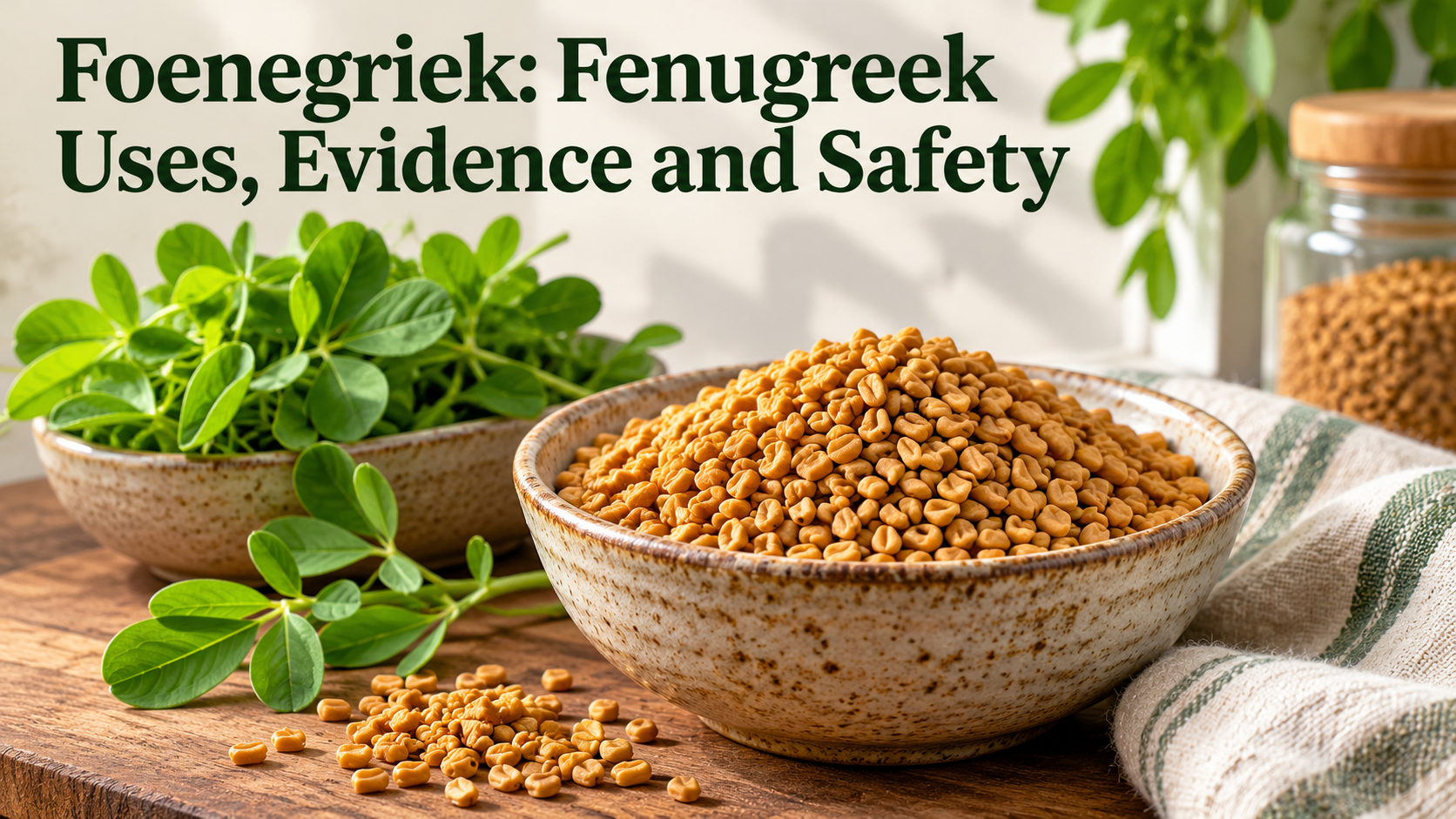
Foenegriek is a search spelling associated with fenugreek, the plant known botanically as Trigonella foenum-graecum. Its seeds and leaves are used as food ingredients, while supplements are marketed for several health purposes. Food use and concentrated supplement use should not be treated as equivalent.
The most useful starting point is to identify the form being discussed. Whole seeds, ground spice, leaves, tea and capsules can differ substantially. A claim about one preparation does not automatically apply to another. This guide focuses on identification, practical buying questions and the limits of the health evidence rather than promising a treatment effect.
Foenegriek: identify the plant and the product
India’s Spices Board identifies fenugreek by the botanical name Trigonella foenum-graecum. Kew’s plant record provides an authoritative botanical reference. A scientific name can help resolve confusion when common names and spelling variants differ across languages.
The name alone still does not tell you what is inside a package. Read whether the product contains seeds, leaves or an extract. Check whether it is a single ingredient or part of a blend. The intended culinary use and any health claim need to be assessed against the actual preparation rather than the broad plant name.
Food ingredients and supplements answer different questions
A spice used in a recipe contributes to the food’s flavour and preparation. A supplement is usually purchased with a different expectation, often involving a claimed physiological effect. The fact that a plant is eaten does not establish the safety or usefulness of every concentrated product made from it.
This distinction matters when reading testimonials. Someone describing a meal is not providing evidence about a capsule. Someone describing a supplement may not identify the formulation clearly enough to compare it with another product. Without that information, an apparently relevant experience may concern something substantially different.
It also matters for quantities. An amount used across a dish is not automatically comparable with repeated intake of an extract. This article does not provide a universal supplement dose. Individual circumstances and the specific product would need appropriate professional assessment, especially where medicines or health conditions are involved.
What the health evidence supports, and what remains uncertain
The US National Center for Complementary and Integrative Health reports insufficient high-quality evidence to establish fenugreek’s usefulness for diabetes or menstrual cramps, and mixed findings for milk supply. These limits should remain visible when a product is advertised with confident health language. A preliminary study is not a guarantee of benefit.
NCCIH also notes digestive side effects, possible allergic reactions and harmful blood-sugar reductions with large amounts. It advises discussing herbal products with a health professional when taking medicines. Amounts above ordinary food use are not considered safe in pregnancy, and safety during breastfeeding is uncertain. Do not use an online article to replace prescribed treatment or individual medical advice.
The research question also matters. A study may assess a particular preparation in a defined group over a limited period. Its result does not automatically establish the same effect for every person, brand or use. Responsible reading keeps the preparation, participants and outcome together rather than extracting only a favourable headline.
How to read a product label
Begin with the ingredient list and intended use. A culinary blend may contain other spices, while a supplement may include several active ingredients. If a reported effect follows use of a combination product, it cannot automatically be attributed to fenugreek alone. Clear identification is essential before comparing claims.
Look for the manufacturer, batch information and storage instructions. These details do not prove that a health claim is valid, but they help identify the actual product. If the package gives little information about its contents or provider, the uncertainty should count against making strong assumptions about what it contains.
Be careful with words such as “natural”, “traditional” and “pure”. They can describe a marketing position without answering questions about evidence, interactions or product quality. The reader still needs to know what the product is, what is claimed and which source supports that claim.
Using a new spice thoughtfully
For ordinary cooking, begin with a recipe that specifies the form required. Whole seeds and ground spice are not always interchangeable in texture or preparation. If the recipe calls for leaves, substituting a different part of the plant can change the result. Follow the recipe rather than assuming the shared name means identical behaviour.
When experimenting, change one element at a time. This makes it easier to understand whether a difference came from the ingredient, the amount or the cooking method. Keep a brief note of what you used if you want to reproduce the dish. Culinary experimentation is more useful when the result can be traced to a clear choice.
Check the rest of the dish too. A new ingredient can be part of a blend or prepared food, and other components may matter to people with dietary restrictions. Read the full label and use normal food-safety practices. A botanical name does not replace practical attention to the product being served.
Storage and shopping questions
Choose a package suited to how often you expect to use the ingredient rather than buying a large quantity solely because the unit price is lower. A product that sits unused is not necessarily better value. The useful comparison includes the form, package information and the likelihood that it will fit your cooking.
Follow the package’s storage directions and keep identifying information if the product will be transferred to another container. An unlabelled jar makes it harder to check ingredients or trace a product later. Clear labelling is particularly useful in a kitchen where several people cook or where similar-looking spices are stored together.
How to assess a dramatic online claim
Identify the promised outcome first. Is the page discussing flavour, nutrition or treatment of a condition? Then examine whether its cited source actually tests that outcome. A traditional use may explain why researchers are interested, but it is not the same as high-quality evidence that the treatment works.
Check whether the page sells the product or earns money from purchases. A commercial relationship does not automatically invalidate every statement, but it should be transparent. The reader needs an account of limitations and possible harms as well as potential benefits. A page that presents only favourable testimonials leaves important questions unanswered.
For related reading about online tools and interpretation, Zingyzon’s Perchance guide illustrates how easily text can be generated. Its story-generator guide explains why fluent draft material still requires human judgement and factual checking. Neither is medical evidence; health claims should be checked against the authoritative sources linked above.
When comparing recipes or products, keep a note of the exact form named by the source. A leaf-based preparation should not silently become a seed-based one in a summary. That small distinction can prevent confusion before the discussion reaches more complicated questions about evidence or safety. Clear identification is useful in ordinary cooking as well as in reading research.
Frequently asked questions
What plant does foenegriek refer to?
The spelling is associated with fenugreek, Trigonella foenum-graecum. Check the actual product label to identify its form.
Are seeds, leaves and extracts equivalent?
No. They are different preparations and should not be assumed to have identical culinary uses or effects.
Is fenugreek proven to increase milk supply?
NCCIH describes the findings as mixed and the evidence as insufficient for a firm conclusion. Discuss individual concerns with a qualified health professional.
Does natural mean risk-free?
No. Side effects, allergy and interactions are possible, and pregnancy requires particular caution with amounts beyond food use.
Should this guide replace prescribed care?
No. It provides general information and source context. Do not change treatment on the basis of a supplement claim or online testimonial.