










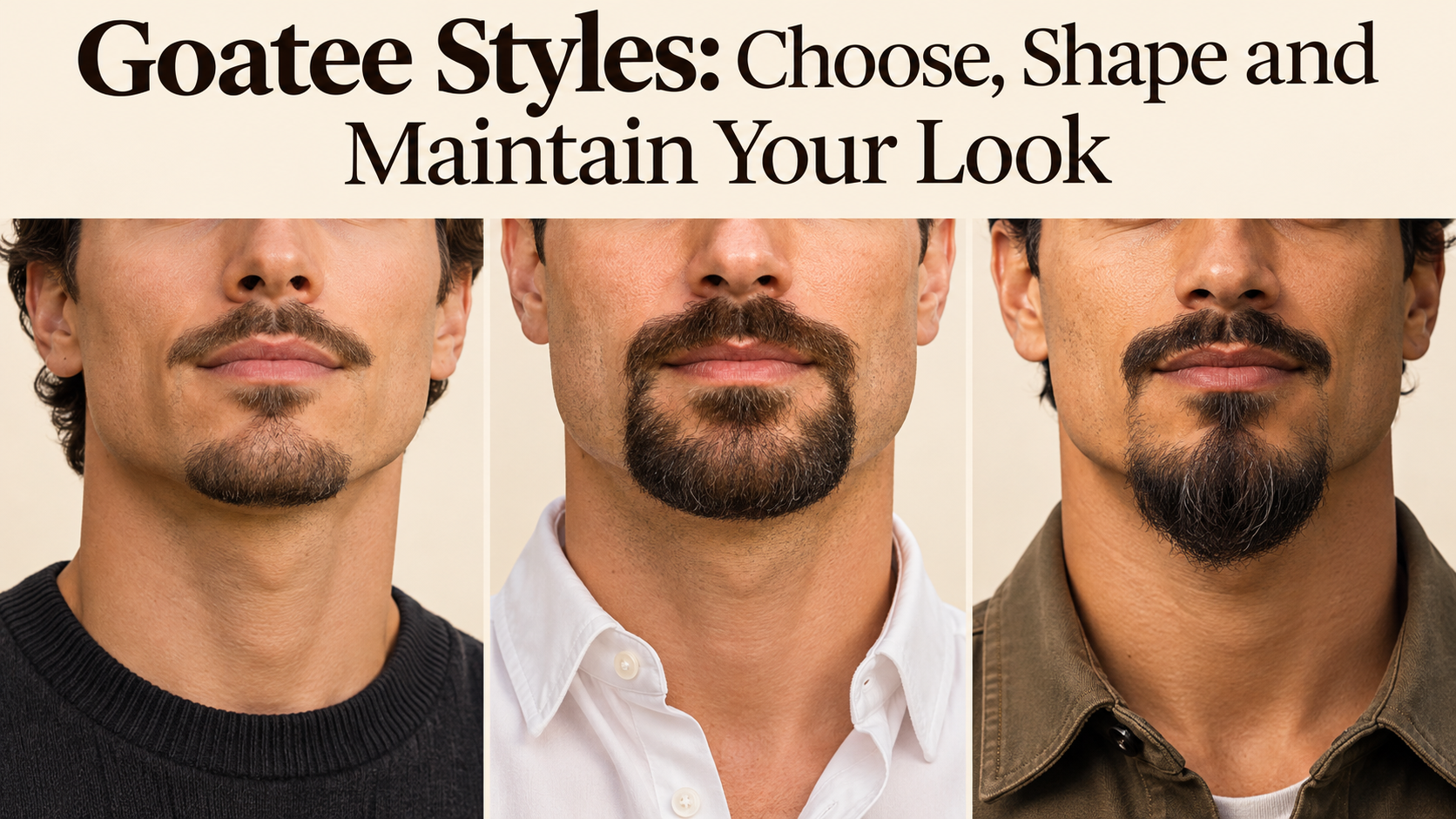
Goatee styles concentrate facial hair around the chin and sometimes connect it to a moustache. The most useful choice depends on where your hair grows evenly, the outline you prefer and how much trimming you want to maintain.
Begin with your existing growth rather than a photograph of someone with a different hair pattern. A neat, comfortable shape that works with your beard is easier to sustain than a design requiring constant corrections. Style names are helpful shorthand, but a clear reference photograph and a description of the outline communicate more reliably with a barber.
Understand the Main Goatee Styles
The classic goatee keeps hair on the chin without requiring a connected moustache. A circle beard joins the chin hair and moustache around the mouth. A disconnected combination leaves a visible separation between the two areas. Extended versions take the outline farther along the lower jaw.
Gillette's circle-beard guide describes the connected moustache-and-chin shape. Its guide to a goatee without a moustache addresses a different arrangement. These distinctions help you describe what you want without assuming every use of “goatee” means exactly the same thing.
Look at the connection points beside the mouth when comparing examples. A narrow gap can make two otherwise similar styles look different. Also notice the lower edge: a rounded chin patch, a pointed outline and a wider shape each create a different overall impression.
Let Your Growth Pattern Guide the Choice
Check which areas grow densely enough to support the outline. If your moustache and chin do not connect evenly, a disconnected style can look more deliberate than repeatedly trying to conceal the gap. A smaller shape may also be easier to keep balanced when cheek growth is uneven.
Do not assume that copying a shape will produce someone else's exact appearance. Hair texture, colour, density and the surrounding face all affect the result. Use a photograph to explain the design, then adapt it to the hair you actually have.
Give the hair enough length to judge the available outline before making a narrow final cut. There is no single growth timetable established here. The practical question is whether you can see the direction, coverage and boundaries well enough to shape them confidently.
Think About Proportion Without Rigid Face Rules
Style guides often assign particular beards to particular face shapes. Treat those suggestions as starting points, not guarantees. The width of the chin area, moustache and side gaps can matter as much as the broad label attached to your face.
A longer pointed shape can emphasise vertical length, while a wider lower outline changes the balance around the mouth and jaw. You can test a modest version before committing to an extreme shape. A barber can help explain which adjustments are possible with your growth.
Consider your preferred everyday appearance as well. A softly trimmed outline and a sharply edged circle beard require different maintenance. Choose the one you want to see between appointments, rather than judging only the freshly styled reference image.
Prepare Before You Shape
Use a clean mirror, good lighting and the appropriate tools for trimming and edging. Comb the hair so you can see its natural direction. Check the trimmer's instructions and attachment settings before placing it against the beard.
Start longer than the final length you expect to want. You can remove more hair after inspecting the result, but you cannot immediately replace a section cut too short. If the tool uses numbered guards, confirm the actual length rather than assuming that different brands use identical numbering.
Keep the first pass conservative. Establish the overall length before making detailed edges. Trying to define every line while the surrounding hair is still uneven can make the shape harder to judge.
Establish the Outline in Small Steps
Decide the approximate width of the chin section and whether the moustache will connect. Work gradually on one side, then compare with the other. Use the centre of your mouth and chin as visual references without demanding perfect mathematical symmetry from a naturally asymmetrical face.
Remove small amounts at the boundaries. Step back from the mirror between passes so you can see the whole shape. A line that looks slightly uneven at extreme close range may appear balanced at a normal viewing distance.
Avoid repeatedly narrowing both sides to correct a tiny difference. That can turn a minor adjustment into an unintended much smaller beard. If the outline becomes difficult to assess, stop and return after combing and checking it under clearer light.
Keep the Moustache and Chin in Balance
With a circle beard, the connections beside the mouth are important to the overall shape. Trim cautiously around them. Removing a connector can change the style from a continuous outline to a disconnected one, which may be acceptable but should be intentional.
Check hair hanging over the lip separately from the rest of the moustache. Work with a suitable small trimming tool and maintain visibility. Do not rely on a rushed pass across an area you cannot clearly see.
For a disconnected style, keep the gap deliberate and consistent enough to read as part of the design. A clear description such as “separate moustache and chin section” is often more useful to a barber than a style name that different people interpret differently.
Shave the Surrounding Area Carefully
Once the retained outline is established, remove surrounding hair with the method suitable for your skin and equipment. Follow product directions and use controlled, light strokes. Do not press harder to compensate for a dull or unsuitable blade.
Gillette's home-trimming guidance discusses preparation and careful shaping. Its commercial product recommendations do not mean you need that particular brand to describe or maintain a goatee. Choose tools according to their instructions and your practical needs.
If shaving causes persistent discomfort or a skin problem, pause rather than repeatedly working the same area. This article addresses grooming style, not diagnosis or treatment. Ask an appropriate professional about a continuing problem instead of attempting to solve it by changing the outline alone.
Create a Maintenance Routine You Will Keep
Check the outer edges and overall length separately. The boundary may need attention before the retained hair needs shortening. Treating every tidy-up as a full restyle can gradually change the design without you noticing.
Keep a photograph of the shape you like under ordinary lighting. Record the tool setting if it helps reproduce the length. Those notes make a later adjustment more deliberate, especially when switching equipment or visiting a new barber.
Clean equipment according to the manufacturer's directions and store it appropriately. A predictable routine is more useful than a large collection of products used inconsistently. Keep the routine focused on preserving the shape you chose rather than introducing a new treatment at every tidy-up.
Explain the Result You Want to a Barber
Bring one or two relevant photographs and identify the feature you like in each. Specify the width, connection, length and lower outline. Ask whether your present growth supports that result and which part will require the most upkeep.
If you want a change, explain what bothers you about the current style. “Too narrow at the chin” gives more direction than “make it better”. Show the photograph at a useful size and explain which elements are references rather than requirements. Your barber can then suggest an adaptation instead of trying to reproduce incompatible details.
A useful first appointment should leave you understanding the shape and how to maintain it. Ask which areas to leave alone between visits. That can prevent an accidental trimming change from undoing the outline you just agreed.
If you experiment with a digital style preview, remember that it may show hair coverage you do not have. Our guide to AI design tools and visual review discusses the need to assess generated visuals. Use such a preview to communicate an outline, then ask the barber what your actual growth can support.
Frequently Asked Questions
What is the difference between a goatee and a circle beard?
The term goatee is used broadly, but a circle beard specifically connects the moustache and chin hair. A classic chin-focused goatee need not include that connection. Use a photograph when precision matters.
Can I wear a goatee if the moustache does not connect?
Yes. A disconnected arrangement or a chin-only style can work with that growth pattern. Choose a clear outline rather than forcing a continuous connection that your current hair does not support.
What length should I choose first?
Start conservatively and shorten gradually after checking the result. Tool settings vary, so read the actual length associated with the guard. There is no universally correct length for every face and hair type.
How often should I trim the edges?
Use the visible growth and your desired level of definition as the guide. Edge maintenance and shortening the beard are separate tasks. A sharp outline may require more frequent attention than a softer style.
What if I accidentally cut one side too narrow?
Stop before chasing symmetry with repeated cuts. Assess the whole shape at a normal distance and decide whether a modest adjustment is sufficient. A barber can help if the outline needs a larger redesign.