









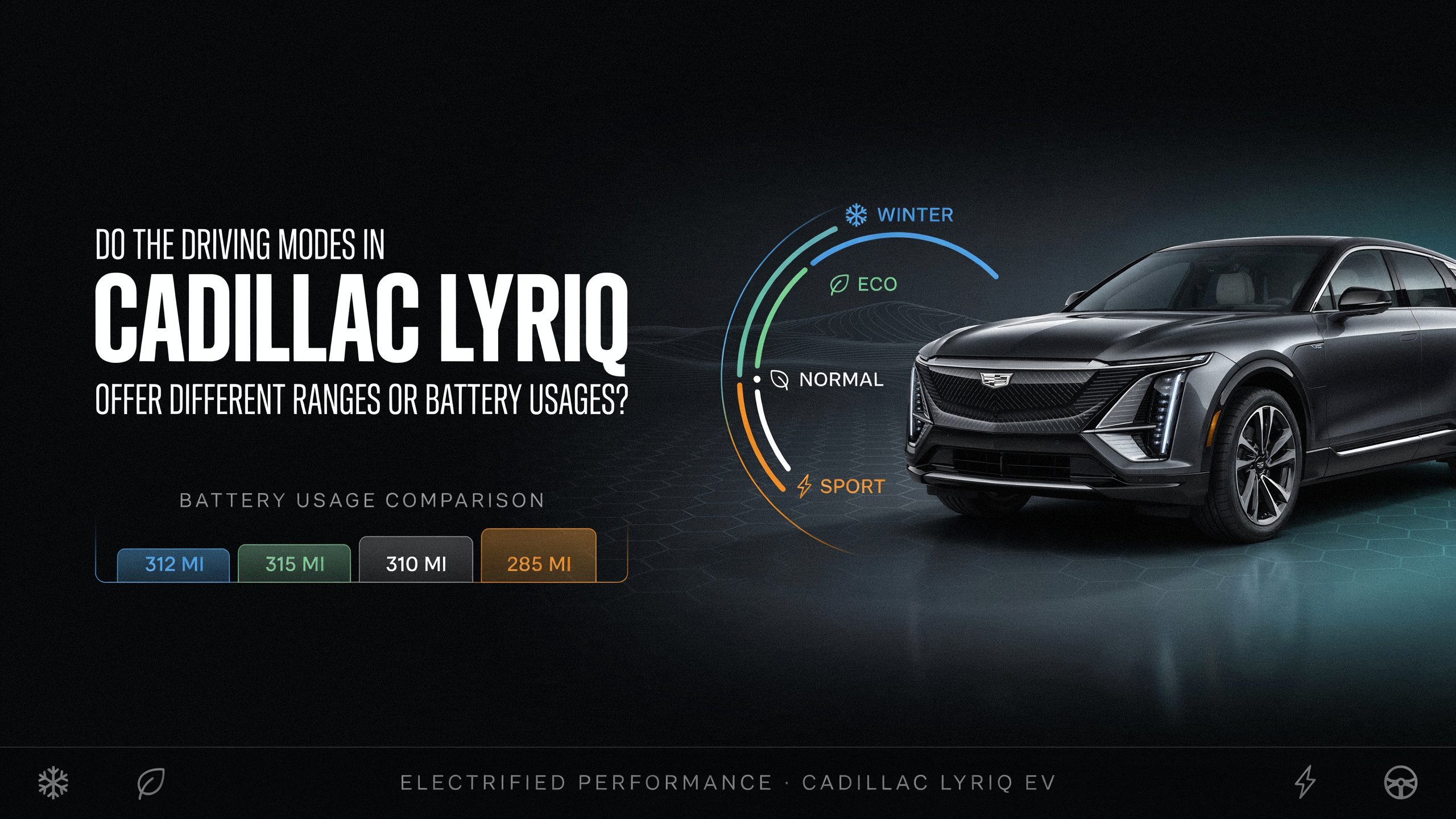
Yes, the Cadillac LYRIQ’s driving modes can influence real-world energy consumption and therefore the range you see, but they do not create separate official battery capacities or different EPA-rated range figures. Cadillac describes the modes as changing vehicle responses such as acceleration, steering, braking and traction behavior, while the LYRIQ’s published range figures are tied to the vehicle’s powertrain configuration rather than a specific drive mode.
For the current 2026 Cadillac LYRIQ, the principal modes are Tour, Snow/Ice, Sport and My Mode. Their effect on range is mostly indirect: a more aggressive mode can encourage stronger acceleration and higher energy demand, while smoother driving in Tour can help efficiency. Actual consumption still depends heavily on speed, temperature, terrain, climate control, tires, payload and driving style.
At a Glance
| Attribute | Verified information |
|---|---|
| Vehicle | Cadillac LYRIQ |
| Model year discussed | 2026 LYRIQ |
| Vehicle type | All-electric luxury SUV |
| Powertrain options | Single-motor RWD and dual-motor AWD |
| Battery | 102 kWh rated energy capacity |
| Maximum published LYRIQ range | 326 miles EPA-estimated for qualifying RWD configuration |
| AWD range | Up to 319 miles EPA-estimated depending on charging configuration/specification |
| Main driving modes | Tour, Snow/Ice, Sport, My Mode |
| Regenerative functions | One-Pedal Driving and Regen on Demand |
| High-performance variant | 2026 LYRIQ-V |
| LYRIQ-V range | 285 miles EPA-estimated |
| Manufacturer | General Motors / Cadillac |
Cadillac lists the LYRIQ’s battery platform at 102 kWh rated energy capacity and says the standard LYRIQ can reach up to 326 miles of EPA-estimated range in single-motor RWD form. Dual-motor AWD versions are listed at up to 319 miles with the standard 11.5-kW charging configuration, while the LYRIQ-V has a separate 285-mile EPA-estimated range.
Do LYRIQ Driving Modes Give You Different Official Range Ratings?
No. Cadillac does not publish a separate EPA range rating for Tour, Sport, Snow/Ice or My Mode. The official range figures are associated with the vehicle’s underlying powertrain and equipment configuration, rather than a menu selection made by the driver.
That distinction matters because EV drivers sometimes assume that selecting a more efficient-sounding mode changes the size of the usable battery. It does not. The LYRIQ still has the same battery system, and selecting a drive mode does not add or remove stored energy from that battery.
What changes is how the vehicle responds to driver inputs and road conditions. Cadillac says Tour is tuned for everyday smooth driving, Sport provides a more immediate torque response and enhanced road connection, Snow/Ice is intended to help prevent wheel spin, and My Mode lets the driver personalize several characteristics.
How Tour Mode Can Help With Efficiency
Tour is the natural choice for drivers who want smooth everyday behavior. Cadillac describes it as the predominant mode for normal driving, with tuning and calibration aimed at a smooth ride. That does not mean the LYRIQ receives a special battery-efficiency rating in Tour, but calmer pedal response can make it easier to drive efficiently.
Energy consumption in an electric vehicle is strongly influenced by how aggressively the accelerator is used. A driver who accelerates gently, maintains moderate speeds and avoids unnecessary rapid changes in speed will generally use less energy than someone who repeatedly demands strong acceleration.
That means Tour may produce better real-world miles per kilowatt-hour for many drivers, but it would be inaccurate to claim that Tour automatically delivers a fixed percentage improvement in range. Cadillac does not publish such a percentage for the LYRIQ.
Does Sport Mode Use More Battery?
Sport mode can increase energy consumption in real-world driving, particularly when its more responsive character leads to harder acceleration. Cadillac says Sport is calibrated for a stronger road connection, more immediate torque response and improved steering at higher speeds.
The important point is that Sport itself should not be described as a separate battery-drain setting. The greater impact usually comes from what the driver does while using Sport.
For example, repeated acceleration from a stop requires substantial electrical power. If Sport encourages the driver to use the LYRIQ’s immediate electric torque more frequently, the vehicle can consume energy faster and the estimated remaining range can fall more quickly.
A driver could theoretically select Sport and still drive gently, producing relatively modest consumption. Conversely, someone using Tour who frequently accelerates hard or drives at high highway speeds can consume considerably more energy.
Typical relationship between mode and energy demand
| Driving situation | Likely effect on energy use |
|---|---|
| Smooth Tour driving | Generally favorable for efficiency |
| Gentle Sport driving | May be similar to normal driving |
| Aggressive Sport acceleration | Usually increases consumption |
| Snow/Ice on slippery roads | Consumption depends heavily on conditions and traction |
| My Mode with strong accelerator response | Can increase consumption if driven aggressively |
| Moderate speed with steady acceleration | Generally more efficient |
| High-speed highway driving | Usually increases energy demand regardless of mode |
This table describes real-world tendencies, not Cadillac-certified range differences. Vehicle speed, weather and road conditions can have a larger impact than simply selecting a mode.
What Does Snow/Ice Mode Do to Battery Usage?
Snow/Ice mode is designed primarily for traction management rather than maximum range. Cadillac says the mode is intended to help prevent wheel spin on snow and slippery surfaces.
The 2025 LYRIQ owner’s manual explains that Snow/Ice driving should be approached carefully and specifically recommends gentle acceleration on slippery roads. It also advises drivers to select Snow/Ice mode in snowy or icy conditions and notes that cold-weather driving can affect energy efficiency.
This means Snow/Ice mode should not be viewed as an economy setting. Its purpose is to make the LYRIQ more controllable when traction is limited.
In winter conditions, the weather itself can have a significant impact on consumption. Lower temperatures affect battery performance, cabin heating requires energy and slippery roads can increase resistance. As a result, a LYRIQ operating in Snow/Ice conditions may use more energy even when the selected mode itself is not directly responsible for the difference.
What Is My Mode, and Can It Change Energy Consumption?
My Mode gives the driver a customized setup rather than a fixed efficiency program. Cadillac says My Mode can change characteristics including accelerator responsiveness, steering feel, braking responsiveness and Electric Vehicle Sound Enhancement.
That flexibility means the energy effect depends on the settings selected and how the vehicle is driven. A gentle accelerator configuration combined with relaxed driving can be relatively economical. A more aggressive configuration may make stronger acceleration easier and therefore raise energy demand.
My Mode is best understood as a personalization tool, not an alternate battery map.
Does Regenerative Braking Increase LYRIQ Range?
Regenerative braking is more directly connected to energy recovery than the basic drive-mode selector. Cadillac says the LYRIQ offers Regen on Demand, which uses the electric motor to decelerate the vehicle and recover some energy into the propulsion battery.
The company also explains that regenerative braking can help create space in the battery for recovered energy, which is one reason Cadillac recommends an 80% daily charge target for battery longevity and allows higher charge levels for longer trips.
Regeneration does not mean every braking event returns all of the energy used for acceleration. Energy is lost in the overall process, so regenerative braking cannot completely eliminate consumption. It does, however, help recover some kinetic energy that would otherwise be dissipated as heat through conventional braking.
Also Read: Zingyzon.com Accounting | Digital Accounting Tools and Business Support
One-Pedal Driving and Drive Modes Are Not the Same Thing
It is important not to confuse One-Pedal Driving or Regen on Demand with the LYRIQ’s driving modes.
The drive modes change the vehicle’s tuning and response. Regenerative systems determine how the vehicle recovers energy during deceleration. Cadillac lists both among its EV driving technologies, but they perform different functions.
In practical terms, an efficient driver can use smooth acceleration, anticipate traffic, maintain steady speed and make effective use of regenerative braking. Those habits can matter more to actual range than simply switching between Tour and Sport.
What Is the LYRIQ’s Battery Capacity?
The current LYRIQ uses a battery platform with a 102 kWh rated energy capacity, according to Cadillac’s specifications. The battery capacity does not change when the driver moves between Tour, Sport, Snow/Ice or My Mode.
The distinction between battery capacity and energy consumption is essential. Capacity refers to how much energy the battery can store, while consumption describes how quickly that stored energy is being used.
A simple example makes the difference clear:
| Concept | Meaning |
|---|---|
| 102 kWh battery | Approximate rated energy capacity of the LYRIQ’s battery system |
| kWh/100 miles or miles/kWh | Measures energy efficiency |
| Drive mode | Changes vehicle behavior and tuning |
| Estimated range | Remaining distance calculated from available energy and expected consumption |
Changing modes affects the final two variables indirectly through driving behavior and operating conditions, but it does not turn a 102-kWh battery into a different-sized battery.
What Is the Official Range of the 2026 Cadillac LYRIQ?
Cadillac lists the 2026 LYRIQ single-motor RWD at up to 326 miles of EPA-estimated range. Available dual-motor AWD versions are listed at up to 319 miles with the standard 11.5-kW charging configuration.
Cadillac also lists an AWD configuration with available 19.2-kW charging at 303 miles EPA-estimated, illustrating why equipment and configuration must be separated from driving-mode discussions. Charging power affects how quickly the battery can be replenished and, in this specification, is associated with a different published range figure.
2026 LYRIQ range figures
| Configuration | Published range |
|---|---|
| Single-motor RWD | 326 miles EPA-estimated |
| Dual-motor AWD with standard 11.5-kW charging | 319 miles EPA-estimated |
| Dual-motor AWD with available 19.2-kW charging | 303 miles EPA-estimated |
| LYRIQ-V dual-motor AWD | 285 miles EPA-estimated |
These figures are manufacturer-published specifications and should not be interpreted as guarantees for every journey. Cadillac notes that actual range varies with factors such as temperature, terrain, battery age, loading, use and maintenance.
Does the LYRIQ-V Work Differently?
The 2026 Cadillac LYRIQ-V adds a more performance-focused driving system. Cadillac says its V-Mode allows customization and provides access to performance functions including Launch Control and Competitive Mode.
The LYRIQ-V has a 102 kWh usable battery energy figure and a Cadillac-estimated 615 horsepower in Velocity Max, with an EPA-estimated range of 285 miles. Its lower range compared with the highest-range standard LYRIQ is primarily associated with its high-performance powertrain and vehicle configuration, not simply the act of selecting a performance mode.
Standard LYRIQ vs. LYRIQ-V
| Specification | 2026 LYRIQ | 2026 LYRIQ-V |
|---|---|---|
| Highest listed range | 326 miles | 285 miles |
| Battery | 102 kWh rated capacity | 102 kWh usable energy |
| Drive options | RWD or AWD | Dual-motor AWD |
| Performance focus | Luxury and balanced driving | High-performance V-Series |
| Special mode | My Mode | V-Mode |
| Maximum stated power | 515 hp Cadillac-estimated for AWD | 615 hp Cadillac-estimated in Velocity Max |
Cadillac describes the LYRIQ-V as its first electric V-Series model and lists a 3.3-second 0-to-60-mph time in Velocity Max, illustrating the different engineering priorities of the performance version.
Which LYRIQ Mode Is Best for Maximum Range?
For everyday efficiency, Tour is the most sensible starting point, particularly for drivers who prefer smooth acceleration and relaxed vehicle responses. Cadillac itself positions Tour as the predominant mode for ordinary driving and smooth ride tuning.
However, the idea that Tour automatically produces a fixed number of additional miles is not supported by Cadillac’s published LYRIQ specifications. The biggest gains generally come from driving habits and environmental conditions.
To maximize real-world range, drivers should focus on:
- Maintaining moderate, steady speeds.
- Avoiding unnecessary hard acceleration.
- Anticipating traffic and reducing sudden braking.
- Using regenerative braking effectively.
- Keeping tires properly inflated.
- Limiting excessive cabin heating or cooling when practical.
- Planning around cold temperatures and difficult terrain.
- Using a higher charge target when a long trip requires it.
Cadillac specifically notes that temperature, terrain, loading, battery age, use and maintenance can affect actual range.
Can Sport Mode Reduce Range Without Changing the Battery Percentage Much?
Yes, at least in the sense that energy consumption can rise faster during demanding driving. Two trips can begin with exactly the same battery percentage and finish with very different remaining percentages because the vehicles experienced different speeds, acceleration patterns, weather and terrain.
An EV’s battery percentage is simply a measure of the energy remaining in the battery. If Sport encourages stronger acceleration, the vehicle can consume that stored energy more quickly.
This is why the most accurate answer is not that “Sport mode has a different range.” The better statement is that Sport can lead to different real-world consumption depending on how it is used.
What Factors Affect LYRIQ Range More Than Drive Mode?
Drive mode is only one piece of the range equation. In many circumstances, environmental and driving factors can be much more significant.
| Factor | Potential effect on range |
|---|---|
| High highway speed | Can substantially increase energy demand |
| Cold temperatures | Can reduce efficiency and affect battery behavior |
| Cabin heating | Requires additional electrical energy |
| Heavy cargo/passengers | Increases vehicle load |
| Hills and mountainous terrain | Increase energy requirements |
| Frequent hard acceleration | Raises power demand |
| Low tire pressure | Can increase rolling resistance |
| Strong headwinds | Increase aerodynamic resistance |
| Aggressive driving | Usually increases consumption |
| Regenerative braking | Can recover some braking energy |
Cadillac explicitly warns that actual range will vary based on multiple operating conditions, and its owner’s information also discusses the impact of winter conditions and energy conservation.
Does Charging at 80% Affect Available Range?
Yes. Charging the battery to 80% naturally gives you less immediately available driving energy than charging it to 100%, but Cadillac recommends an 80% target for daily use as part of its battery-care guidance. For longer journeys, the company says the target can be increased to provide additional range.
This is another reason the estimated range shown in the vehicle should not be confused with the official EPA number. A fully charged LYRIQ can have the potential to approach its rated range under suitable conditions, while an 80%-charged vehicle starts with less stored energy.
The selected driving mode does not change that basic relationship.
The Bottom Line on Cadillac LYRIQ Driving Modes and Range
Do the Driving Modes in Cadillac LYRIQ Offer Different Ranges or Battery Usages? They can produce different real-world energy consumption, but Cadillac does not assign separate official EPA range ratings to Tour, Sport, Snow/Ice and My Mode. The modes primarily alter vehicle tuning and behavior, while actual battery use depends on how the vehicle is driven and the conditions in which it operates.
For most drivers seeking efficient everyday use, Tour is the logical default because it is designed around smooth normal driving. Sport can consume more energy when its sharper response leads to frequent acceleration, while Snow/Ice prioritizes traction and My Mode allows the driver to create a customized setup.
The most important takeaway is simple: drive mode can influence efficiency, but it does not change the LYRIQ’s physical battery capacity or create a separate official range rating.
Frequently Asked Questions
Does Sport mode reduce Cadillac LYRIQ range?
It can reduce real-world range when Sport mode is accompanied by more aggressive acceleration or higher-performance driving. Cadillac does not publish a specific percentage range reduction for Sport mode.
Is Tour mode the most efficient LYRIQ mode?
Tour is designed for normal driving and a smooth ride, making it the sensible choice for efficiency-focused daily driving. However, Cadillac does not publish an official EPA range figure specifically for Tour mode.
Does changing drive modes change the LYRIQ battery size?
No. Changing modes does not change the physical battery capacity. Cadillac lists the 2026 LYRIQ battery platform at 102 kWh rated energy capacity.
Does Snow/Ice mode save battery?
Not necessarily. Snow/Ice mode is designed to improve traction on slippery roads rather than maximize efficiency. Cold weather, road conditions and tire grip can all affect energy consumption.
What is the 2026 Cadillac LYRIQ’s maximum EPA-estimated range?
The 2026 LYRIQ reaches up to 326 miles of EPA-estimated range in a single-motor RWD configuration listed by Cadillac. Available dual-motor AWD versions are rated up to 319 miles, while the high-performance LYRIQ-V is rated at 285 miles.
Also Read: CnLawBlog Explained | Origins, Content, and Credibility