








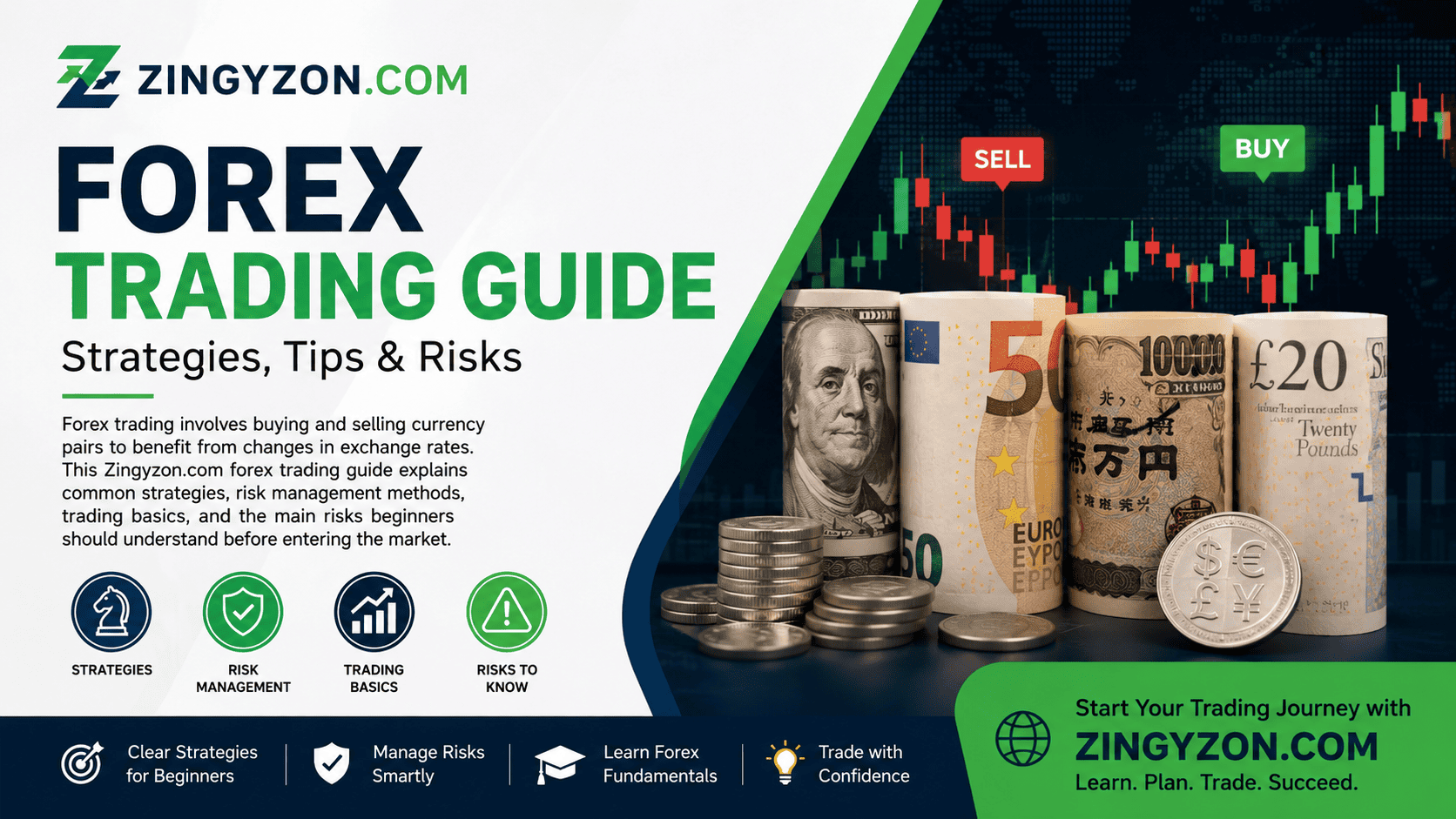
Forex trading involves buying and selling currency pairs to benefit from changes in exchange rates. This Zingyzon.com forex trading guide explains common strategies, risk management methods, trading basics, and the main risks beginners should understand before entering the market.
What Is Forex Trading?
Forex, short for foreign exchange, is the global market for trading currencies. A forex trade always involves two currencies because one currency is exchanged against another.
For example, EUR/USD compares the euro with the US dollar. If a trader expects the euro to rise against the dollar, the trader may buy EUR/USD. If the trader expects the euro to fall, the trader may sell the pair.
Forex prices can change because of many factors, including:
- Interest rate decisions
- Inflation
- Economic growth
- Employment data
- Central bank policies
- Political developments
- Global market sentiment
- Supply and demand for currencies
Forex trading can be conducted through different types of financial products and trading arrangements. Retail traders commonly access the market through a broker or dealer.
How Forex Currency Pairs Work
Currency pairs contain a base currency and a quote currency.
For example, in EUR/USD:
- EUR is the base currency.
- USD is the quote currency.
- The exchange rate shows how many US dollars are needed to buy one euro.
Common currency pairs include:
| Currency Pair | Currencies | Common Description |
|---|---|---|
| EUR/USD | Euro and US dollar | Major pair |
| GBP/USD | British pound and US dollar | Major pair |
| USD/JPY | US dollar and Japanese yen | Major pair |
| USD/CHF | US dollar and Swiss franc | Major pair |
| AUD/USD | Australian dollar and US dollar | Major pair |
| USD/CAD | US dollar and Canadian dollar | Major pair |
| NZD/USD | New Zealand dollar and US dollar | Major pair |
Major pairs generally receive significant attention because they involve widely traded currencies. However, trading activity, spreads, liquidity, and costs can vary depending on the broker, product, market conditions, and time of day.
What Is a Forex Quote?
A forex quote normally contains a bid price and an ask price.
The bid is the price at which a trader can sell. The ask is the price at which a trader can buy.
The difference between these prices is called the spread.
For example, if EUR/USD has a bid of 1.1000 and an ask of 1.1002, the spread is 0.0002.
Trading costs can affect results, especially for traders who enter and exit positions frequently. Investor.gov notes that transaction costs can sometimes turn an otherwise profitable trade into a losing transaction.
What Is Leverage in Forex Trading?
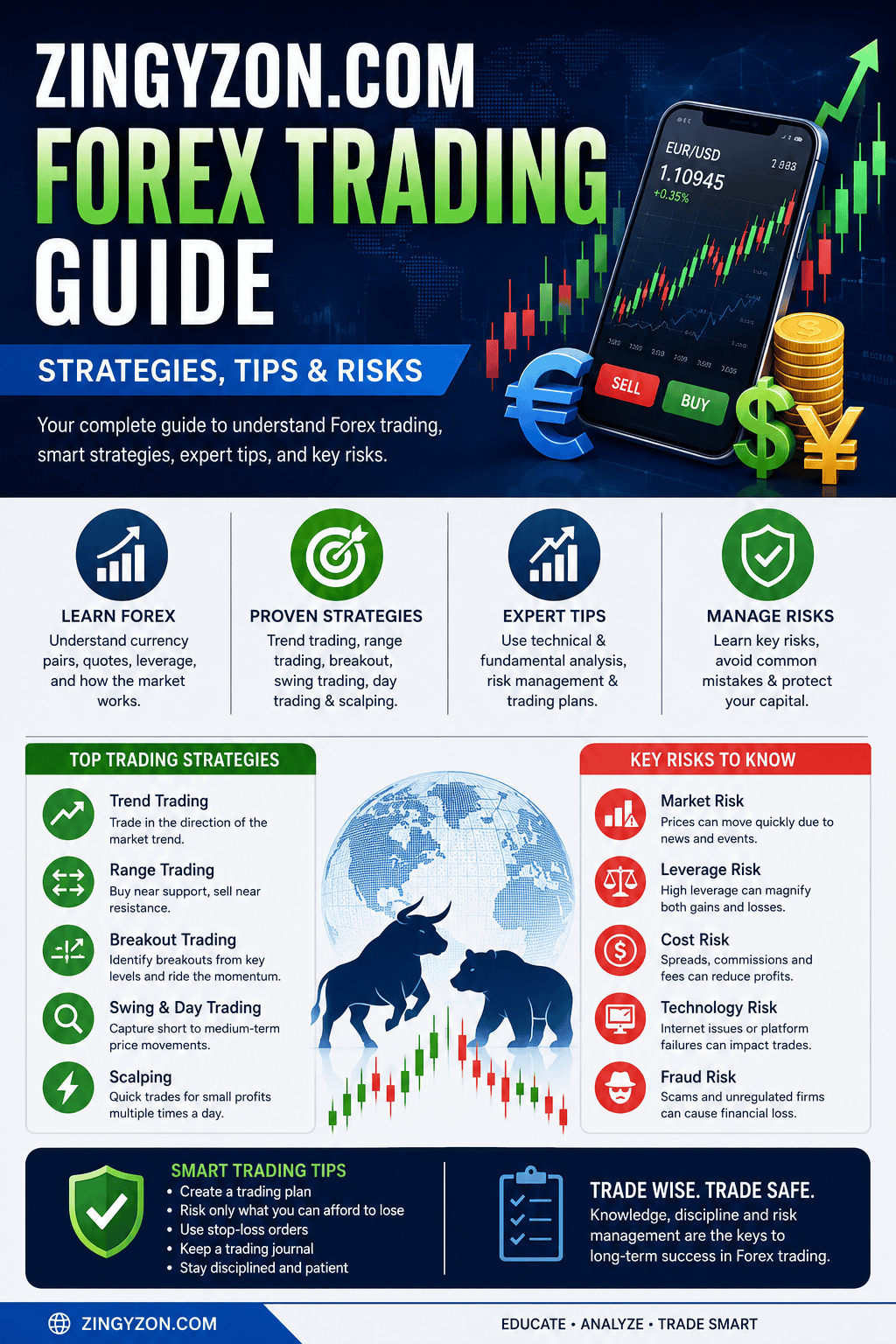
Leverage allows traders to control a position larger than the amount of capital they provide as margin.
For example, a broker may require a certain percentage of a position as margin. A 2% margin requirement would mean that a $100,000 position requires $2,000 in margin.
Leverage can increase potential gains, but it also increases potential losses. A relatively small currency movement can produce a large change in the value of a leveraged position.
Investor.gov warns that leverage can result in the loss of an investor’s entire initial capital and, depending on the agreement, potentially more than the initial deposit.
For this reason, beginners should understand margin, leverage, position size, and liquidation rules before placing a leveraged trade.
Main Forex Trading Strategies
There is no single strategy that works in every market condition. Traders normally select a method based on market behavior, trading timeframe, risk tolerance, and personal objectives.
Trend Trading
Trend trading attempts to identify the general direction of a currency pair.
A trader may look for:
- Higher highs and higher lows during an uptrend
- Lower highs and lower lows during a downtrend
- Breakouts from established price ranges
- Support and resistance levels
- Moving average signals
The basic idea is to trade in the direction of an established market trend rather than constantly trying to predict reversals.
Range Trading
Range trading focuses on currency pairs that move between established support and resistance levels.
A trader may look for buying opportunities near support and selling opportunities near resistance.
This approach can become less effective when a strong breakout occurs. Therefore, traders need a plan for managing positions if the market moves outside the expected range.
Breakout Trading
Breakout trading focuses on price movements outside an established trading range.
A breakout may occur when the market moves above resistance or below support.
Traders may examine:
- Price momentum
- Trading volume where relevant
- Previous resistance and support
- Economic news
- Market volatility
A breakout is not automatically a valid trading signal. False breakouts can occur when price briefly moves beyond a level before returning to the previous range.
Swing Trading
Swing traders usually attempt to capture price movements that develop over several days or weeks.
This approach requires less constant monitoring than very short-term trading. However, positions can remain exposed to overnight and weekend market developments.
Swing traders often combine technical analysis with fundamental information.
Day Trading
Day trading involves opening and closing trades during the same trading session.
Day traders may focus on short-term price movements and use technical indicators, chart patterns, support and resistance, and market news.
Frequent trading can increase transaction costs. It can also increase the effect of emotional decisions and poor risk management.
Scalping
Scalping is a very short-term approach that attempts to capture small price movements through multiple trades.
Because individual profits may be small, traders often rely on tight execution, suitable spreads, disciplined risk controls, and a well-tested process.
Scalping can be demanding and may not be suitable for inexperienced traders.
Technical Analysis for Forex
Technical analysis uses historical price and market data to study possible future price movements.
Common technical analysis tools include:
Moving Averages
Moving averages smooth price data over a selected period.
Traders may use them to identify trends or compare short-term and long-term price movements.
Common examples include:
- Simple Moving Average
- Exponential Moving Average
A moving average does not guarantee that a price will move in a particular direction. It is a tool for analyzing market behavior.
Relative Strength Index
The Relative Strength Index, or RSI, measures recent price momentum.
It is commonly used to identify periods when an asset may have moved strongly in one direction.
RSI should not be treated as an automatic buy or sell signal. Strong trends can keep an indicator at elevated or depressed levels for extended periods.
Support and Resistance
Support is a price area where buying interest may appear.
Resistance is a price area where selling pressure may appear.
These levels can help traders identify potential entry points, stop-loss locations, and profit targets.
However, support and resistance are not guaranteed barriers. Prices can move through them during strong market movements.
Candlestick Patterns
Candlestick charts display price movements over a specific period.
Traders may study patterns such as:
- Doji
- Engulfing patterns
- Hammer
- Shooting star
- Inside bar
Candlestick patterns should normally be considered alongside broader market conditions rather than used independently.
Fundamental Analysis in Forex
Fundamental analysis examines economic and financial factors that can influence currency values.
Important factors include:
Interest Rates
Central bank interest rate decisions can strongly affect currency markets.
Higher interest rates may influence capital flows and currency demand, although the actual market response depends on expectations and broader economic conditions.
Inflation
Inflation data can influence expectations about future monetary policy.
Unexpected changes in inflation may produce rapid movements in currency markets.
Employment Data
Employment reports provide information about economic conditions.
Strong or weak employment data can influence expectations about interest rates and economic growth.
Gross Domestic Product
GDP measures economic activity.
Changes in economic growth expectations can affect how traders value a country’s currency.
Central Bank Decisions
Central banks influence monetary policy through interest rates, statements, asset purchases, and other policy measures.
Forex traders often monitor central bank announcements because unexpected policy changes can create significant volatility.
Technical vs Fundamental Forex Analysis
| Factor | Technical Analysis | Fundamental Analysis |
|---|---|---|
| Main focus | Price and market data | Economic and financial conditions |
| Common tools | Charts, indicators, patterns | Economic reports, rates, policy |
| Typical use | Entry and exit analysis | Broader market direction |
| Timeframe | Short to long term | Often medium to long term |
| Main limitation | Signals can fail | Market reaction can be unpredictable |
Many traders use both approaches instead of relying exclusively on one.
Forex Risk Management
Risk management is one of the most important parts of forex trading.
A strategy can generate good signals and still lose money if position sizes are too large or losses are not controlled.
Set a Maximum Risk Per Trade
Traders can establish a predefined amount they are willing to risk on each trade.
The amount should be based on the trader’s financial situation and risk tolerance.
A smaller position size can reduce the impact of an individual losing trade.
Use Stop-Loss Orders Carefully
A stop-loss order can be used to automatically close a position when price reaches a specified level.
However, a stop-loss does not guarantee the exact execution price under every market condition. Rapid price movements and gaps can affect execution.
Avoid Excessive Leverage
High leverage can magnify both gains and losses.
Using lower leverage and smaller position sizes can help reduce the effect of individual market movements.
Maintain a Trading Plan
A trading plan can define:
- Entry conditions
- Exit conditions
- Maximum risk
- Position size
- Trading timeframe
- Markets to trade
- Conditions for avoiding trades
A written plan can help reduce impulsive decisions.
Common Forex Trading Mistakes
Beginners often make avoidable mistakes when they enter the market without a clear process.
Trading Without a Plan
Entering trades based on random price movements can make performance difficult to evaluate.
A trading plan provides clear rules for when to enter, exit, or avoid a trade.
Using Too Much Leverage
Excessive leverage can make relatively small price movements produce large account losses.
This is one of the most important risks to understand before trading forex.
Chasing Losses
Trying to recover a losing trade immediately can lead to larger positions and additional losses.
A losing trade should not automatically change the trader’s risk rules.
Overtrading
Opening too many positions can increase transaction costs and expose the account to unnecessary risk.
More trades do not automatically mean better results.
Following Guaranteed Signals
No trading signal can guarantee future profits.
The CFTC warns that claims of guaranteed or unusually high returns are important warning signs when evaluating forex opportunities.
Ignoring Trading Costs
Spreads, commissions, financing charges, and other expenses can affect overall performance.
Traders should understand all applicable costs before opening an account.
How to Choose a Forex Broker
Choosing a regulated and reputable broker is an important part of forex trading.
Before opening an account, traders should check:
- Which regulator supervises the broker.
- Whether the firm’s registration can be independently verified.
- The available trading products.
- Margin and leverage conditions.
- Spreads and commissions.
- Deposit and withdrawal rules.
- Customer support options.
- Account terms and risk disclosures.
- The firm’s disciplinary or regulatory history where applicable.
- Whether the broker clearly identifies its legal entity and business address.
The CFTC recommends researching OTC forex dealers before depositing funds and checking registration and disciplinary information where applicable.
Regulatory requirements differ between countries and financial products. Therefore, traders should verify the rules that apply to the broker and product they intend to use.
Forex Trading Scams to Watch For
Forex trading attracts legitimate market participants, but it is also used by fraudsters.
Common warning signs include:
- Guaranteed profits
- Extremely high returns with little risk
- Pressure to deposit money immediately
- Unsolicited investment offers
- Requests to communicate through private messaging apps
- Unregistered trading firms
- Fake trading results
- Requests for cryptocurrency-only payments
- Problems withdrawing funds
- Demands for additional fees to release supposed profits
- Claims that an automated system cannot lose
The CFTC specifically warns that scammers may use social media, messaging applications, fake trading platforms, automated systems, and unrealistic profit claims to attract victims.
A legitimate forex strategy cannot eliminate market risk.
Major Risks of Forex Trading
Forex trading involves substantial financial risk.
Market Risk
Currency prices can move against a position because of economic data, political events, central bank decisions, or unexpected developments.
Leverage Risk
Leverage increases the size of both gains and losses relative to the capital used.
Liquidity Risk
Market liquidity can vary by currency pair and market conditions. Lower liquidity can contribute to wider spreads or more difficult execution.
Cost Risk
Spreads, commissions, financing charges, and other costs can reduce returns.
Counterparty Risk
In some retail OTC forex arrangements, the trader deals directly with a dealer rather than a centralized exchange. Investor.gov notes that off-exchange forex trading has additional risks, including the absence of a central marketplace and central clearing.
Technology Risk
Trading depends on internet connections, trading platforms, devices, and broker systems.
Technical failures can affect access to positions and orders.
Fraud Risk
Unregistered firms and fraudulent schemes can result in the loss of deposited funds.
The CFTC states that about two out of three retail forex traders lose money each quarter, based on profitability data from registered dealers.
A Simple Forex Trading Process
Beginners can use a structured process to reduce avoidable mistakes.
| Step | What to Do |
|---|---|
| 1 | Learn basic forex terms |
| 2 | Understand currency pairs |
| 3 | Study leverage and margin |
| 4 | Research regulated brokers |
| 5 | Learn technical and fundamental analysis |
| 6 | Create a written trading plan |
| 7 | Practice with a suitable demo account if available |
| 8 | Define risk limits |
| 9 | Review trading costs |
| 10 | Keep records of trades and results |
A demo account can help a beginner learn how order types and trading platforms work without immediately risking live capital. However, simulated trading does not remove the financial and emotional challenges of real-money trading.
How to Build a Forex Trading Plan
A useful trading plan should answer several basic questions.
Which Currency Pairs Will You Trade?
Choose a limited group of currency pairs that you understand.
Monitoring too many markets can make it difficult to follow economic events and price movements.
Which Timeframe Will You Use?
Decide whether the strategy focuses on short-term, daily, or longer-term movements.
The timeframe should match the strategy and the amount of time available for market analysis.
What Creates an Entry Signal?
Define the conditions required before entering a trade.
For example, a strategy may require a specific combination of trend direction, support or resistance, and confirmation from a technical indicator.
Where Will You Exit?
Determine the conditions for both profitable and losing trades before entering the position.
How Much Can You Risk?
Set a clear risk limit and avoid changing it simply because a trade moves against you.
Keeping a Forex Trading Journal
A trading journal can help identify repeated mistakes and measure whether a strategy follows its rules.
A basic journal may include:
- Date and time
- Currency pair
- Entry price
- Exit price
- Position size
- Stop-loss level
- Profit target
- Reason for entering
- Reason for exiting
- Result
- Mistakes or rule violations
Reviewing these records can help separate a strategy’s actual results from individual lucky or unlucky trades.
Does Forex Trading Guarantee Profit?
No. Forex trading does not guarantee profit.
Currency markets are affected by changing economic conditions and unexpected events. A strategy that performs well during one period may perform poorly under different market conditions.
The CFTC states that past performance does not guarantee future success and warns that automated systems, trading signals, and similar tools cannot consistently predict future market movements.
Claims of guaranteed forex income should therefore be treated with caution.
Can Beginners Start Forex Trading?
Beginners can learn about forex trading, but understanding the risks should come before risking real money.
A sensible learning process includes:
- Understanding currency pairs
- Learning basic chart analysis
- Studying economic indicators
- Understanding leverage
- Learning order types
- Researching broker regulation
- Practicing risk management
- Testing a strategy
- Keeping a trading journal
Forex should not be treated as a guaranteed source of income.
Zingyzon.com Forex Trading Guide: Key Points
This Zingyzon.com forex trading guide covers the core areas a beginner should understand before considering forex trading.
The most important points are:
- Forex involves trading currencies in pairs.
- Currency prices can change quickly.
- Leverage increases both potential gains and losses.
- Technical analysis studies price behavior.
- Fundamental analysis studies economic and financial factors.
- Risk management is essential.
- Trading costs can affect profitability.
- No strategy guarantees profit.
- Broker regulation should be independently verified.
- Guaranteed-return claims are a major warning sign.
- Traders should only risk money they can afford to lose.
Zingyzon currently presents itself publicly as a broad informational website covering areas such as technology, business, health, home improvement, and travel. This guide should therefore be read as educational information about forex trading rather than a claim that Zingyzon.com is a forex broker, investment manager, or regulated financial service provider.
Frequently Asked Questions
What is forex trading?
Forex trading is the buying and selling of currencies with the aim of benefiting from changes in exchange rates. Currency trades are normally made through currency pairs such as EUR/USD or GBP/USD.
Is forex trading risky?
Yes. Forex trading can involve substantial losses. Leverage can magnify losses, and market prices can move quickly. Investor.gov states that forex trading may not be appropriate for all investors.
What is the best forex strategy?
There is no universally best forex strategy. Trend trading, range trading, breakout trading, swing trading, day trading, and scalping all use different methods and have different risks.
Is high leverage good for beginners?
High leverage can significantly increase risk. Beginners should first understand how leverage and margin affect both profits and losses before considering leveraged trading.
Can forex trading make you rich?
Forex trading does not guarantee wealth or income. Claims of quick or guaranteed profits should be treated as potential warning signs.
How can I reduce forex trading risk?
Risk can be managed by using appropriate position sizes, limiting leverage, understanding trading costs, using a written trading plan, and avoiding money that is needed for essential expenses.
Are forex trading bots guaranteed to make money?
No. Automated trading systems cannot guarantee future profits. The CFTC warns that no technology can consistently predict future market movements.
What should I check before choosing a forex broker?
Check the broker’s regulatory status, legal entity, trading conditions, fees, withdrawal rules, customer support, risk disclosures, and regulatory history where available.
Can I lose more than my initial forex deposit?
Depending on the product, broker agreement, and applicable regulations, losses can potentially exceed the initial amount deposited. Traders should carefully read the account agreement and understand the applicable protections before trading.
Is forex trading suitable for everyone?
No. Forex trading involves significant risk and may not be suitable for every investor. Anyone considering it should understand the product, costs, leverage, and potential losses before committing money.
You can read it’s also: Guest Post Zingyzon.com for SEO, Brand Visibility, and Quality Content